

Mountain Valley Teacher Brings Global Health Learning to Life for Fifth Graders
When Amanda Bryant, a fifth-grade teacher at Mountain Valley Community School in RSU 10, applied for the 2025 Global Health Teacher Fellowship Program, she hoped to find new ways to spark curiosity and bring real-world learning into her classroom. What she gained—and what she gave her students—was far more powerful, though.
Bryant was selected as one of just 12 educators nationwide to participate in the prestigious fellowship, which engages teachers in designing innovative learning experiences that explore interconnected global health inequities through journalism and reporting. Over 28 hours of professional development, Bryant collaborated with educators and journalists from across the United States and around the world to build lessons that connect students to underreported global health issues in meaningful ways.
“This was truly an eye-opening experience,” Bryant said. “I learned so much about my own teaching practice but also about the similarities and differences among educators working in very different settings. It helped broaden my perspective and strengthened my commitment to bringing real-world issues into my classroom.”
For her project, Bryant introduced her fifth graders to the work of Bangladeshi scientist Dr. Firdausi Qadri, whose groundbreaking research on cholera, an infection caused by ingesting food or water contaminated with bacteria, focuses on preventing the disease through vaccines and access to clean water. In Bryant’s class, many students were surprised to learn that cholera is still a major global health threat and that clean-looking water is not always safe.
The unit began with students examining images of water and discussing what “clean” truly means. From there, Bryant guided them through an in-depth exploration of Pulitzer Center reporting by journalist Martin Enserink, carefully breaking down the science, social impact, and global inequities tied to cholera. Together, the class analyzed misinformation, studied the science behind disease transmission, and examined how access to clean water and vaccines varies around the world.
The learning culminated in student-created call-to-action projects, in which students selected a focus area: promoting clean water access, encouraging vaccination, or educating others about cholera. Their work included posters, digital presentations, and even original podcasts created using Canva.
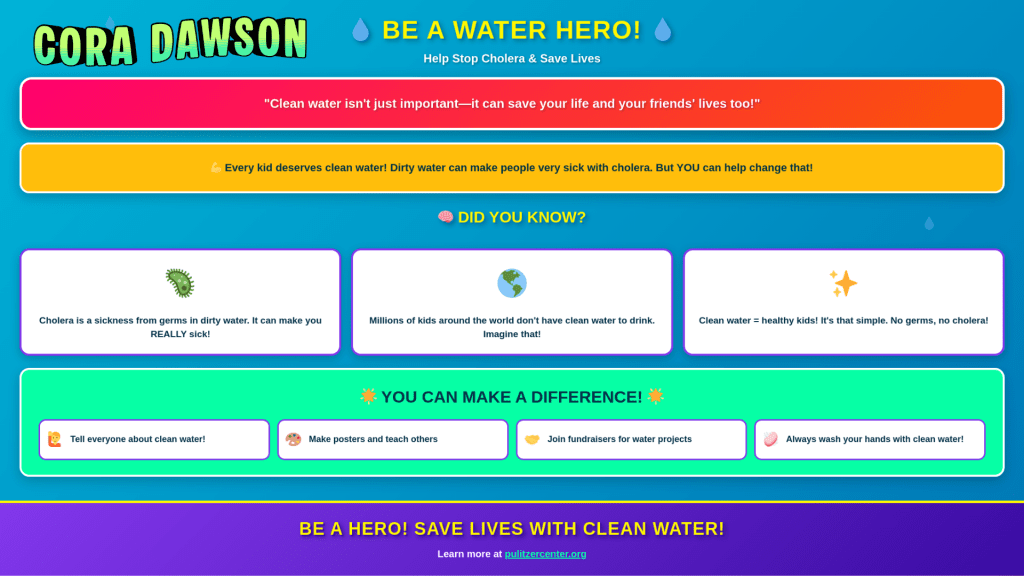
“Some of the most creative projects I had were podcasts that students created on Canva,” Bryant said. “This was a really ambitious project for fifth graders who have just started using Canva this year in my classroom. I was very proud of them and their dedication to this project.”
Through the project, students were also able to recognize how much impact one scientist can have—and how vital support and funding are to that work. Students also developed a deeper understanding of global health inequities and the importance of critical thinking.
“One of the biggest takeaways was that just because something looks safe doesn’t mean it is,” Bryant explained.
Bryant said the fellowship reshaped her approach to teaching and assessment. Through collaboration with fellow educators, she gained new strategies for measuring student learning beyond traditional tests. She is already applying those lessons in her current American Revolution unit, offering students multiple ways to demonstrate understanding through projects and creative work.
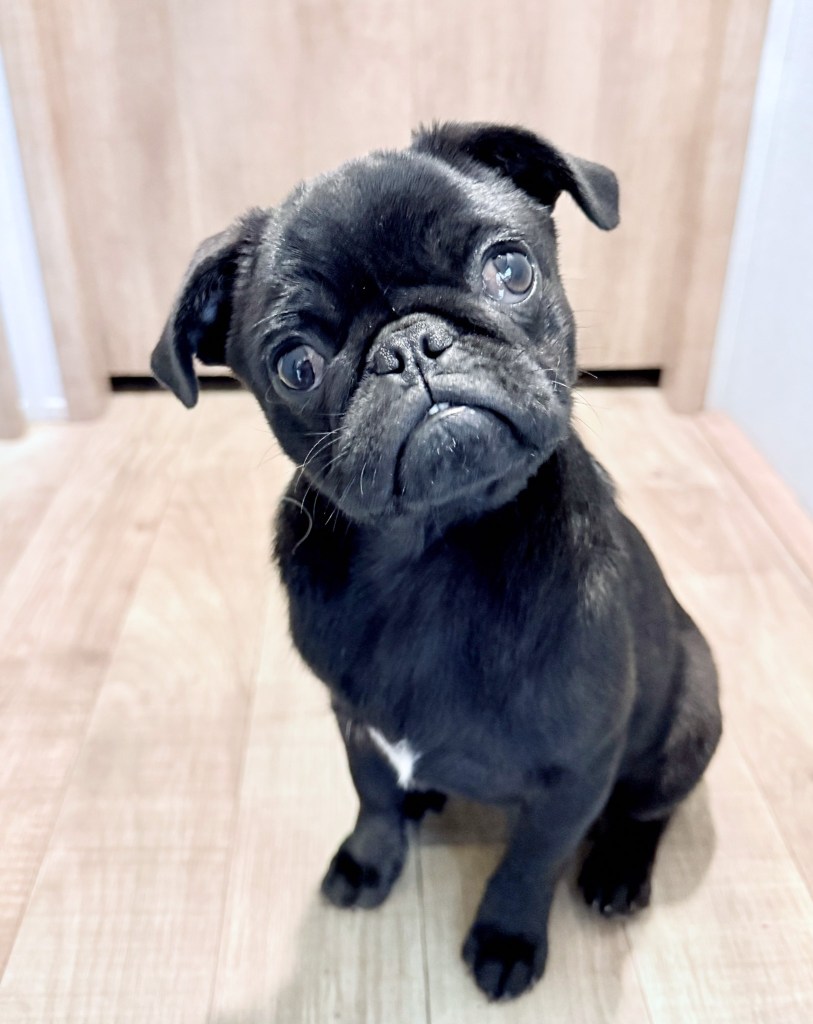
Outside the classroom, Bryant balances her teaching with work as an EMT and the joyful challenge of training Murph, her six-month-old, two-pound service dog. Yet. she says her motivation always circles back to her students.
Growing up with dyslexia, Bryant struggled academically and often felt disconnected from school.
“I want to be the teacher for my students that I didn’t always have,” Bryant said. “I want them to know that their challenges don’t define their potential.”
That philosophy drives everything she does—from global health projects to service dog training.
“It’s all about the spark,” Bryant said. “Seeing students realize that history is happening now, or watching Murph master a new skill—it’s about connection, curiosity, and growth. I want my students to see that they don’t have to stay in one lane. They can be historians, scientists, advocates, and dog lovers all at once.”
Soon, Bryant’s work—along with projects from the other fellowship participants—will be featured on the Pulitzer Center website, extending the impact of her classroom far beyond western Maine.
For her students, though, the greatest lesson may be the simplest: Learning can change the way you see the world—and your place in it.
This story idea was written in collaboration with Mountain Valley Community School. To submit a good news story to the Maine DOE, please fill out the good news submission form.
Related
Legal Disclaimer:
EIN Presswire provides this news content "as is" without warranty of any kind. We do not accept any responsibility or liability for the accuracy, content, images, videos, licenses, completeness, legality, or reliability of the information contained in this article. If you have any complaints or copyright issues related to this article, kindly contact the author above.
